
GHI is dedicated to advancing the global harmonization of food safety laws and regulations through scientific consensus, education and advocacy.
Founded in 2004 as a joint activity of the Institute of Food Technologists (IFT) International Division and the European Federation of Food Science and Technology (EFFoST), the Global Harmonization Initiative is a network of individual scientists and scientific organizations working together to promote harmonization of global food safety regulations and legislation through sound science.
What drives us?

A number of food scientists from all over the world find it unacceptable that 1 billion people in the world go hungry while safe and nutritious food is destroyed due to differences in food safety regulations and laws that cannot be scientifically justified.
GHI’s objective is to achieve consensus on the science that underlies food regulations and legislation to ensure the global availability of safe and wholesome food products for all consumers. GHI anticipates that the elimination of regulatory and legislative differences between countries will have a significant, positive impact on several fronts:
- Global harmonization of food regulations and laws will help reduce world hunger and foodborne disease. Untold amounts of food are destroyed each day, barred from ports of entry based on unnecessary trade barriers. Harmonized international food regulations will help ensure that safe food is not destroyed for wrong reasons.
- Global harmonization of food regulations and laws will eliminate trade barriers that masquerade as food safety protections. Differing food safety policies, requirements or rules based on insufficient or contradictory science not only reduce the effectiveness of public health protection measures but can greatly reduce the availability of food that is actually safe to consume.
- Global harmonization of food regulations and laws will help reduce the potential for pandemic foodborne illness outbreaks. Harmonized regulations will support the use of effective, scientifically sound food protection measures to better address this challenge.
- Global harmonization of food regulations and laws will boost technological innovation. Harmonizing global regulations will aid in the adoption and application of new technologies to ensure the safety and quality of the food supply for consumers worldwide.
For government and public health agencies responsible for overseeing the safety of the international food supply, harmonization of food safety and quality standards and regulatory requirements will bring:
- A higher level of confidence that risk-reduction strategies and food safety measures are effective.
- Assurance that decisions taken are based on science and not on political agendas that are in conflict with public health goals.
- The ability to better allocate available resources where they have the highest impact on the most pressing foodborne disease challenges.
Our Strategy

To build consensus among scientists on global harmonization of food safety regulations, GHI organizes scientific working groups, member meetings, workshops and symposia to further its collaborative work and provide educational outreach to key stakeholders.
At the core of GHI’s strategy are its Working Groups (WGs), whose members are scientists and experts from industry, government and academia with expertise in food safety, nutrition, regulation and trade. The WGs continually collect and evaluate available data to produce white papers or position statements on controversies and issues in food science, regulation, law and trade and recommendations about opportunities for global harmonization.
In addition to publishing WG findings, GHI communicates the principles of food safety science to influencers and decision makers—from the general public and the press, to politicians, policymakers and regulatory authorities—through our Ambassador Programme, digital platforms and presentations. Our aim is to improve understanding and better inform all stakeholders so that objective scientific concepts, not political expediency or media hype, become the basis of crafting meaningful, harmonized food safety legislation and regulation in all countries.
Read more about GHI Working Groups …
Our Governance

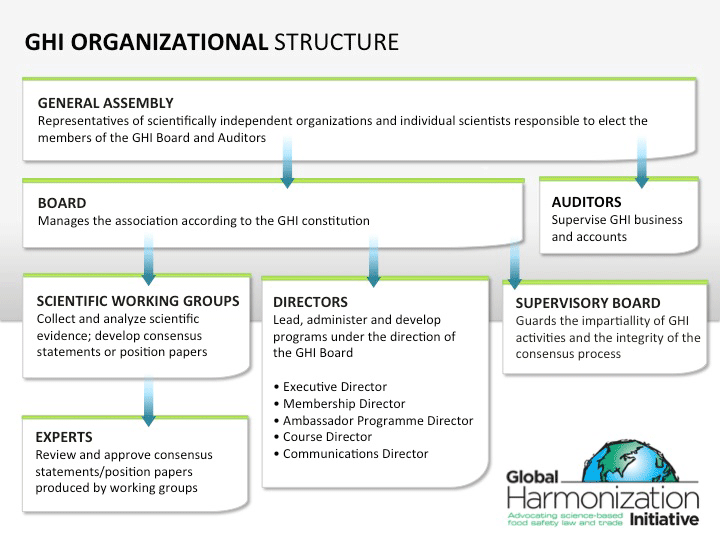
Our governing body is the GHI Board, a group of highly respected food scientists, regulatory experts and industry professionals. The board is supported by a leadership team of volunteer directors, coordinators and advisors, who bring a wealth of expertise and skillsets to GHI’s operations.
GHI’s Supervisory Board, consisting of representatives of scientific organizations and stakeholders, elects candidates to the board, ensures the impartiality of all GHI activities and guards the integrity of GHI’s consensus process.
Learn about Our Leadership Team …
Our Non-Profit Status

GHI is a registered non-profit association in Austria (ZVR: 453446383).
In 2012, GHI was granted ANBI status in The Netherlands. The ANBI abbreviation stands for ‘Algemeen Nut Beoogende Instellingen,’ or Institutions Aimed at the Common Good. To receive this designation at least 90% of an organization’s efforts must be focused on the general good. With ANBI status, gifts from private donors can be deducted against income tax in The Netherlands as well as all other EU Countries. The ANBI Fiscal number is: 823848607.
Downloads
About GHI: Global Framework, Global Change
GHI Charter & Supervisory Board
GHI Vereinsstatuten (German original)
GHI Constitution (English translation)